There is a particular kind of exhaustion that only comes from a badly managed Umrah trip. And it has nothing to do with the distance, the heat, or the crowds.
The Question Nobody Asks Out Loud
You have been thinking about Umrah for a while now. Perhaps it has been on your mind for years. In between the demands of work, family, and everything else that fills a life well-lived.
When the time finally feels right, the first instinct is often to search online. And within minutes, you are looking at a page full of package prices, hotel star ratings, and promotional banners. Everything looks roughly the same. Everything promises the best experience.
But something about it doesn’t feel quite right.
Not because you are being unreasonable. Not because you expect extravagance. But because somewhere, quietly, you know that a trip of this magnitude spiritually, logistically, emotionally deserves more than a price comparison exercise.
That feeling is worth paying attention to.
What Most People Don’t Realise Until They’re Already There
There is a version of Umrah that many Malaysians have experienced, or heard about from someone they trust. The flight departs late, the luggage takes too long, the hotel is further from the Haram than the brochure suggested. The mutawwif responsible for leading the group through ibadah is managing sixty people at once and cannot give proper attention to anyone. Your elderly mother is struggling to keep up. There is no one to call.
None of this is dramatic. None of it is unusual. And that is precisely the problem.
For a trip that most Muslims prepare for months, that carries such weight of intention and meaning, these are not minor inconveniences. They are disruptions to something sacred. And they are, in most cases, entirely avoidable.
The difference between a well-managed Umrah and a poorly managed one rarely shows up in the brochure. It shows up at two in the morning when your parents need assistance and there is no one on the ground. It shows up when the group is rushed through Tawaf before you have had a moment to simply be present. It shows up in the quality of rest, in the clarity of mind, in whether you return home feeling spiritually restored or just relieved that it’s over.
This is not a small distinction.
Why the Modern Malaysian Muslim Is Rethinking How They Approach Umrah
Something has shifted in the way a growing number of Malaysians particularly those in their thirties, forties, and fifties now think about performing Umrah.
It is not about wanting lavishness. It is not about five-star indulgence for its own sake. It is something quieter and more considered than that.
It is the recognition that how you perform Umrah shapes what you bring home from it.
A doctor who spends her working life making high-stakes decisions does not want to spend her sacred leave troubleshooting logistics. A business owner who has spent twenty years building something does not want to feel uncertain about whether his parents are comfortable and cared for. A family travelling with young children or ageing grandparents does not want to navigate the complexity of Makkah and Madinah without genuine, knowledgeable support.
These are people who understand the value of doing things properly. They have applied that standard to their careers, their homes, and their families. It is entirely natural and deeply sensible to apply the same standard to their ibadah.
What they are looking for is not premium for the sake of premium. They are looking for the confidence that comes from knowing: this has been handled well.
What “Premium Umrah” Actually Means And What It Doesn’t
The word luxury tends to conjure images of gold fixtures and champagne service. In the context of Umrah, it means something altogether different.
Premium Umrah is not about extravagance. It is about absence of friction.
It is the difference between a hotel that is a ten-minute walk from Masjidil Haram manageable for a healthy thirty-five-year-old, genuinely difficult for someone in their seventies with arthritic knees and a hotel where your elderly parent can hear the adhan, feel the proximity, and make their way to prayer without distress.
It is the difference between a mutawwif who is guiding a group of eighty and one who leads a smaller, properly structured group with the patience and knowledge to explain what is happening, why it matters, and how to perform each step correctly.
It is the difference between arriving at King Abdulaziz International Airport after a long flight and standing in confusion, and having someone already there, composed, ready to receive you.. handling documentation, managing luggage, moving the group with calm efficiency.
It is the difference between food that is an afterthought and meals that are thoughtful, halal-certified, familiar enough to sustain the body through the demands of ibadah.
None of these things are opulent. All of them matter enormously.
The Hidden Cost of Cheap Umrah
This is a conversation worth having plainly, because it affects real families.
When an Umrah package is priced significantly below the market, something has been removed from it. This is not cynicism. it is simply how economics works. And the things that get removed first are always the things that are hardest to quantify in a brochure: the quality of ground handling, the attentiveness of the mutawwif, the proximity of the hotel, the responsiveness of support when something goes wrong.
You do not discover these gaps when you book. You discover them when you are already there.
The family who saved for months and chose the most affordable option available sometimes returns home having spent more on taxis because the hotel was too far, on extra meals because the catering was inadequate, on medical care because the itinerary was too demanding for their parents, on the quiet toll of a spiritually significant journey that felt, in the end, like a management exercise.
This is not to suggest that every affordable package is poorly managed, or that every expensive one is worth the price. It is to say that price alone is not a proxy for quality, and that for a journey of this importance, the due diligence deserves to go beyond comparing numbers.
Performing Umrah with Elderly Parents: A Different Kind of Responsibility
For many Malaysian families, performing Umrah with parents is not just a travel decision, it is a deeply felt act of filial devotion and gratitude. The opportunity to make that journey together carries enormous emotional and spiritual weight.
It also requires a different level of care.
The sacred sites of Makkah and Madinah are demanding environments. The distances within Masjidil Haram alone can be significant. The heat, particularly outside of the cooler months, requires careful management. Crowds during peak times require patient, experienced guidance. The physical and emotional demands of ibadah, performed with full presence and intention, ask something of the body.
For elderly parents particularly those with limited mobility, chronic health conditions, or simply the natural vulnerability that comes with age, these factors require genuine planning, not improvised accommodation.
A properly arranged elderly-friendly Umrah programme considers the pace of movement through ibadah. It ensures hotel rooms are accessible and appropriately located. It accounts for rest, for medical preparedness, for the availability of wheelchairs where needed. It places the mutawwif in a role that is genuinely pastoral not merely logistical.
When these arrangements are in place, something remarkable happens. The elderly parent who was anxious about whether they could manage finds that they can. The adult child who was quietly worried about being responsible for everything discovers that there is a capable team around them. The journey becomes what it was meant to be: an act of worship, together not a test of endurance.
The Mutawwif: The Role Most Travellers Underestimate
In the organisation of an Umrah programme, the mutawwif is perhaps the most consequential figure and the one most commonly overlooked when comparing packages.
A mutawwif is the guide who accompanies the group through the rituals of Umrah: the Tawaf, the Sa’i, the visits to significant sites in Makkah and Madinah. In the best cases, a skilled mutawwif does far more than direct foot traffic. They create the conditions for genuine ibadah.
They explain the meaning behind each step. They create space for reflection. They move at a pace that allows the traveller to be present not merely to be completing a checklist. They know when to speak and when silence is more appropriate. They are calm under pressure, patient with questions, and genuinely knowledgeable about the spiritual and historical significance of what surrounds them.
The difference between an attentive, experienced mutawwif and one who is managing too many people with too little support is not subtle. It changes the quality of the entire journey.
This is one of the dimensions of Umrah that simply cannot be assessed from a brochure. It requires either direct experience or the kind of trust that comes from working with an agency that understands the difference and takes it seriously.
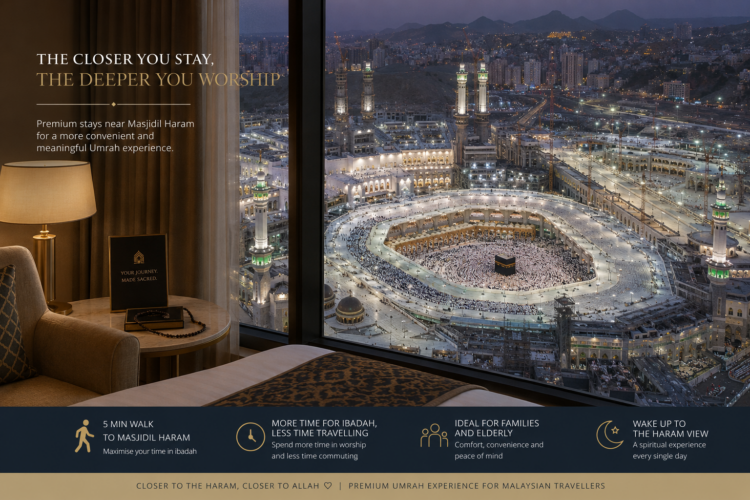
On Hotel Proximity: Why Distance Is Never Just Distance
One kilometre from Masjidil Haram. To most travellers looking at a map before departure, this sounds entirely reasonable – a short walk, a brief journey.
In practice, for a group of pilgrims performing multiple prayers daily, navigating crowds, managing heat, and returning to rest between ibadah, that distance is a significant factor in the quality of the entire experience.
A hotel within close walking distance of the Haram allows for something that cannot be replicated by any amount of compensating logistics: spontaneity of worship. The ability to return to the Masjid for an additional prayer. The capacity to rest properly between Fajr and Dhuhr. The ease of moving between ibadah and recovery without planning it like an expedition.
For elderly pilgrims, this is not a comfort preference – it is a practical necessity.
Hotels in the immediate vicinity of Masjidil Haram vary considerably in quality, management, and what they actually provide for their guests. Understanding which properties genuinely serve Umrah pilgrims and which rely on their location alone is the kind of knowledge that only comes from direct experience on the ground.
This is one of the reasons why the guidance of a trusted, experienced Umrah travel partner continues to matter, even in an age when it is possible to book almost anything independently.
Why Premium Travellers Still Choose to Travel with an Agency
There is an assumption sometimes made that independent travel is inherently superior that booking everything yourself is more sophisticated, more in control.
For leisure travel to familiar destinations, this may often be true. For Umrah, it is a more complicated calculation.
The logistics of Umrah operate within a framework of Saudi regulations, visa requirements, and ground arrangements that change regularly and require local knowledge and established relationships to navigate well. The quality of what you receive, the hotel room, the ground transportation, the mutawwif depends heavily on the relationships your operator has built with suppliers on the ground, and on their track record of managing groups in a demanding environment.
An experienced, reputable Umrah agency does not simply book flights and hotels. They negotiate for proximity. They vet the guides they use. They have systems for handling the unexpected because in travel, the unexpected happens. They have people you can call. They carry responsibility, not just receipts.
For someone who values their time, their peace of mind, and the quality of what is arguably the most significant journey they will undertake in a given year, this is not a luxury consideration. It is a sensible one.
The Widad Philosophy: Properly Done, or Not at All
At Widad Tours & Travel, there is a conviction that runs through everything from how programmes are structured to how clients are communicated with to how groups are looked after on the ground.
That conviction is this: a well-handled Umrah is not more expensive to provide – it is more intentional to provide.
The families and professionals who travel with Widad are not looking for the cheapest option. They have, in most cases, already looked at those options and found themselves asking the same quiet question: but will it actually be done properly?
Widad’s answer to that question is built into how the agency operates. Smaller group sizes. Hotels selected for proximity and quality, not just star rating. Mutawwif who are chosen for knowledge, composure, and genuine pastoral skill. Ground handling that anticipates the needs of the group rather than simply responding to problems after they arise. Support that is available not theoretically, but in practice.
The result is a journey that feels, to those who experience it, significantly different from what they might have expected. Not because of what was added, but because of what was removed: the uncertainty, the friction, the quiet anxiety of not being sure whether things were truly in hand.
That is what peace of mind looks like in practice. Not a feeling – a standard.
What to Look for When Choosing Your Umrah Programme
Whether you choose to travel with Widad or conduct your own search, these are the dimensions that actually determine the quality of an Umrah experience:
Hotel proximity to Masjidil Haram and Masjid Nabawi. Not star rating in isolation, but walkable distance and suitability for your group’s composition.
Mutawwif quality and group size. A guide who knows the ibadah deeply and leads a manageable group is worth more than any hotel upgrade.
Ground handling. Airport arrivals and departures, transportation between cities, luggage management – these are the moments when proper coordination reveals itself.
Programme pace. An itinerary designed for meaningful worship versus one designed to process the maximum number of pilgrims in the minimum time.
Accessibility provisions. If you are travelling with elderly parents, what specifically is in place for them – not as an afterthought, but as a designed element of the programme?
Who to call. Not a general hotline, but a named person with authority and on-the-ground presence who will actually resolve a problem.
Track record. Years of experience, repeat clients, and genuine referrals from people you can speak to.
For Those Who Are Ready
If you have read this far, something in this has resonated. Perhaps you have been thinking about Umrah for some time. Perhaps you have been waiting for the right arrangement not just the right price. Perhaps you want to bring your parents, and you want to be certain that they will be looked after.
The team at Widad Tours & Travel is not here to sell you a package. They are here to understand what you need, and to tell you honestly whether they can meet it.
That conversation is always worth having.
Speak to the Widad team about your Umrah programme →
Premium Umrah packages differ primarily in the quality of ground handling, hotel proximity to the Haram, mutawwif expertise, group size, and the level of coordination and support provided throughout the journey. The distinction is less about visible luxury and more about the absence of avoidable friction – the difference between a journey that unfolds smoothly and one that requires constant management from the traveller.
Yes, for most people who value their time and peace of mind. The benefits of proper handling, responsive support, experienced guidance, well-located accommodation, structured itineraries.. apply regardless of physical fitness. The question is not whether you need the support, but whether you prefer to spend your spiritual journey focused on ibadah or on logistics.
Umrah with elderly parents requires specific advance planning: hotel rooms close to the Haram (to minimise walking distance), wheelchair availability where needed, a programme pace appropriate for the group, and a mutawwif experienced in guiding mixed-ability groups. A reputable agency will address these requirements as part of the initial programme design, not as add-ons. Speak clearly about your parents’ specific needs at the outset.
Ideally, within a five to ten-minute walk. For elderly travellers or those making multiple daily visits to the Masjid, proximity closer than this is highly preferable. Distance matters more than most travellers anticipate before they arrive particularly for early morning prayers and late-night ibadah.
Because the value of an experienced Umrah agency lies not in what they book, but in how they handle what cannot be booked: the relationships with ground suppliers, the judgment calls when circumstances change, the presence of responsible, knowledgeable people on the ground. For a journey of this significance, that accountability matters.
Outside of the Hajj season, the cooler months of November through February offer more comfortable temperatures in Makkah and Madinah. Ramadan Umrah carries particular spiritual significance and remains highly sought after, though it requires careful planning given the scale of attendance. Your travel agency should advise on timing based on your group’s specific needs and preferences.
For premium programmes, particularly those with limited group sizes and high-quality hotel allocations, booking three to six months in advance is advisable. For Ramadan programmes, demand is considerably higher and early planning – six months or more is strongly recommended.